

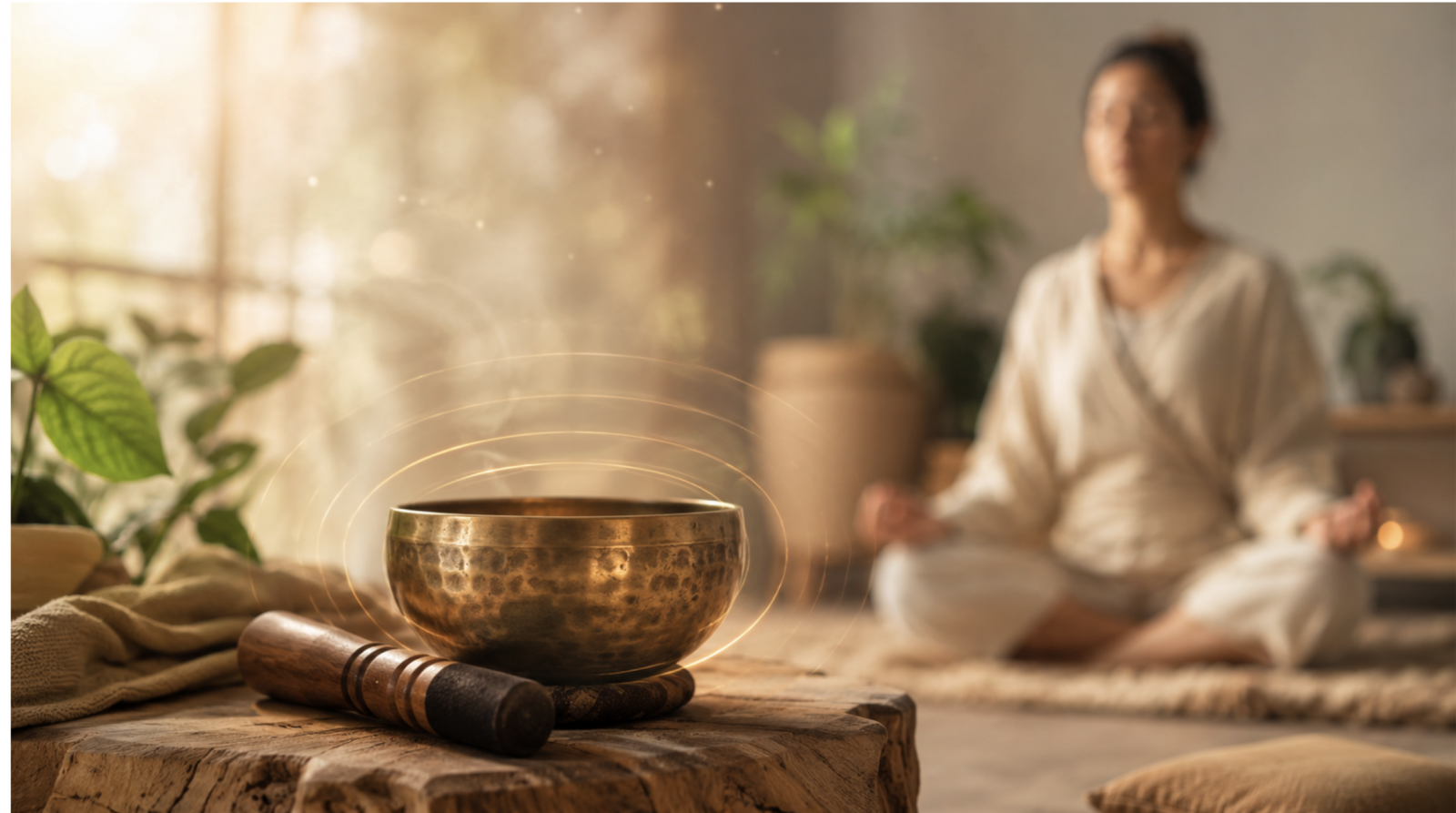
If your mind races the moment your head hits the pillow, you already understand the problem. An overactive mind rarely announces itself as “stress.” It shows up as replaying a conversation from three days ago, mentally drafting emails at midnight, or sitting down to relax and immediately feeling restless.
Sound healing has become one of the more accessible ways to interrupt that loop. It asks very little of you — no perfect posture, no emptying your mind, no prior experience. You listen, and the sound does much of the work.
This guide explains what sound healing actually is, why it seems to settle a busy mind, and how to begin with a single instrument: the singing bowl.
What Sound Healing Actually Means
Sound healing is the practice of using sustained tones and vibration to shift your attention and physical state. Practitioners work with singing bowls, gongs, tuning forks, chimes, and the voice.
It is not new. Metal singing bowls are commonly associated with Tibetan and Himalayan traditions and are believed to have been used in meditation and ritual practices for centuries. What is relatively new is the context — sound is now used in yoga studios, therapy offices, corporate wellness rooms, and increasingly at home.
The core idea is simple: a long, continuous tone gives your attention something to rest on. A busy mind struggles with silence because silence leaves room for thought. Sound fills that room without demanding effort.
A note on expectations: sound healing is a supportive practice for relaxation and focus. It is not a treatment for medical or psychiatric conditions, and it is not a substitute for professional care.
Why an Overactive Mind Responds to Sound
Sound gives attention a single anchor
Most people who “can’t meditate” are actually struggling with anchoring. Watching the breath is subtle work — the breath is quiet, internal, and easy to lose. A singing bowl tone is loud, external, and lasts thirty seconds or more.
When you follow a tone from its strike to its complete fade, you are practicing sustained attention without trying to. That is the entire mechanism, and it is why beginners often find sound easier than silent sitting.
Vibration is felt, not just heard
Struck metal bowls produce vibration you can feel in your chest, hands, and jaw. This matters because an overactive mind is usually a mind that has left the body — thinking about the future, revisiting the past, everywhere except here.
Physical sensation is always present tense. Feeling a vibration pulls attention back into the body, which is where the nervous system actually calms down.
Slow, predictable sound signals safety
A racing mind is often paired with a nervous system on alert. Rapid, unpredictable sound raises alertness; slow, resonant, predictable sound tends to lower it. Many people notice their breathing lengthen on its own within a few minutes of listening — no instruction required.
Reported effects vary from person to person, and much of the research is still early. Treat sound healing as a practice worth testing on yourself rather than a guaranteed outcome.
Singing Bowls: The Best Entry Point for Beginners
Of all sound healing tools, singing bowls are the easiest place to start. They are portable, they need no power source, and one bowl is genuinely enough.
Two broad categories exist:
- Metal bowls (Himalayan style) — Made from a metal alloy, usually hand-hammered. They produce warm, complex tones with multiple overtones. The sound is textured and layered.
- Crystal bowls (quartz) — Machine-made from fused quartz. They are often described as producing a clear, sustained tone with prominent harmonics that many listeners perceive as pure and resonant.
Neither is better in the abstract. Metal bowls tend to suit people who want depth, warmth, and character. Crystal bowls suit people who prefer clarity and a clean sustained note.
For beginners looking for a first instrument, handmade metal bowls are usually the more forgiving choice. Their overtones make small technique errors less noticeable, and they respond well to both striking and rimming.
Why handmade bowls sound different
This is where craftsmanship stops being a marketing point and becomes an audible difference.
A machine-pressed bowl is uniform. A hand-hammered bowl is not — its wall thickness varies slightly across the surface, and those variations create the overtones that give the sound its richness and movement. It is the same reason a hand-built instrument sounds different from a factory one.
This is why handmade singing bowls from Kathmandu hold their reputation. Kathmandu and the surrounding Nepali valleys have sustained a metalworking tradition across generations, and the bowls produced there are shaped by hammer rather than press. Artisan workshops offering handmade Nepal singing bowls typically test each bowl by ear before it leaves the bench, which is why no two are identical even within the same size.
If you are comparing options, it is worth listening to sound samples side by side before deciding on size and tone.
How to Choose Your First Bowl
Choosing the best singing bowls for your own use comes down to four practical questions.
- What size?
Smaller bowls (4–6 inches) produce higher, brighter tones and are easy to hold in the palm. Larger bowls (8 inches and up) produce lower, deeper tones with longer sustain — better for room-filling sound, heavier to travel with. For a first bowl, 5–7 inches is a reliable middle ground.
- What tone do you actually like?
Ignore claims about specific frequencies “fixing” specific problems — that is where sound healing marketing gets ahead of the evidence. The tone that helps you relax is the tone you enjoy hearing. Trust your ear.
- Struck or rimmed?
Striking the side gives a bell-like tone that swells and fades. Rimming — running a mallet around the edge — produces a continuous singing note. Rimming takes practice; striking works immediately. Most healing singing bowls handle both, but if you want to rim, a slightly thicker-walled bowl is more cooperative.
- Does it come with a proper mallet and cushion?
An undersized mallet will never bring out a bowl’s full voice, and a bowl resting directly on a hard surface will sound choked. These accessories are not upsells — they are part of the instrument.
A Simple 10-Minute Practice
You do not need a class to begin. Try this.
- Sit comfortably with the bowl on its cushion in front of you or resting on your open palm.
- Strike the outer wall once, gently, about an inch below the rim.
- Follow the sound all the way down until you can no longer hear it. Do not rush to strike again.
- Notice the gap after the sound ends. Sit in it for two or three breaths.
- Repeat for ten minutes. When your mind wanders — and it will — return to the next strike without judgment.
That is the whole practice. Wandering is not failure; noticing the wandering is the training.
If you would like more structured guidance, this walkthrough of singing bowl meditation from Calm covers additional techniques for pairing bowls with breathwork.
Common Beginner Mistakes
- Striking too hard: A harsh strike produces a clang, not a tone. Let the bowl ring rather than forcing it.
- Playing continuously: The silence between tones is where the settling happens. Do not fill every second.
- Buying too many bowls too early: One bowl you play daily beats a set of five you use twice.
- Expecting immediate results: Many people report noticing gradual changes with regular practice, but the experience varies from person to person.
- Chasing frequency claims: Choose by sound, not by specification.
Where Sound Healing Fits in Daily Life
Sound healing is most useful as a transition tool — a marker between one state and another.
- Before sleep: as a signal to the nervous system that the day is closed
- Between work blocks: to clear mental residue from the previous task
- Before or after yoga: to lengthen the settling period
- During journaling: as low background resonance rather than active focus
- After difficult conversations: to discharge tension before it compounds
Five focused minutes daily will do more for an overactive mind than an hour once a month. Consistency is the variable that matters.
conclusion
An overactive mind is not a character flaw and it does not need to be forced into stillness. It needs something steady to hold onto. Sound provides that — a tone that lasts long enough for attention to settle on it, and a vibration real enough to bring you back into your body.
Start small. One bowl, one strike, ten minutes. Choose an instrument whose sound you genuinely enjoy, because you will only keep a practice you look forward to. A well-crafted bowl from a traditional Nepali workshop will serve you for decades, and its tone tends to become more familiar and more useful the longer you work with it.